





Industry
The Complete Guide to Sanding Discs: Features and Types Explained

When it comes to making rough surfaces smooth, it all started by hand and with natural materials. Sanding originated way before the 13th century, when the first sandpaper-like material was invented in China. This was a sheet of gum which was used to finesse shells, seeds and sand into parchment.
Nowadays, sanding is part of a wide range of manufacturing practises with the most common being machining and joining. The tools have also taken a big jump into electric power, making them crucial for everything from welding to woodworking projects, as they help make the whole process quicker and easier.
What Matters in a Sanding Disc?
Attachment
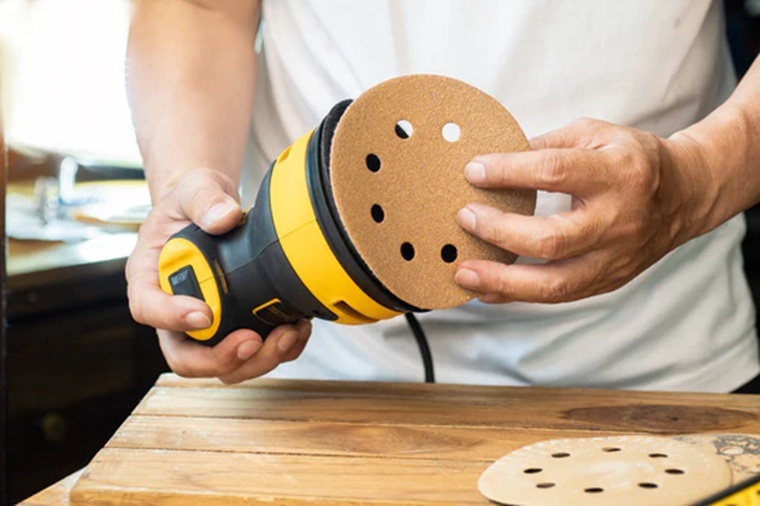
Without sanding discs, said tools wouldn’t be usable and without the correct attachment, a disc wouldn’t be compatible. Since there is a different material sanding disc for every project, there is an attachment for each. The design of the disc is usually what determines the type of attachment it’s used with, be it with the help of an adhesive, loops, hooks or a threaded attachment – more on that later.
Size & Shape
Both the size and shape of the disc are determined by the type of sanding tool you use. For assistance, if you’re using an orbital sander, you can only go for either a square or a rectangle. A finishing sander is only used with circular discs. The size of the discs usually ranges from 80mm to 225mm, depending on the size of the sander and the size of the surface you want to sand down.
Grit
The grit level determines the finish you’ll end up with, and the lower the grit number, the coarser the disc and vice versa. If you go for 40 and 60 grit discs, you’ll get a coarse sanding surface, but if you go for 80 and 100 grit level discs, you get a medium level of abrasiveness. With 120 and 200 grit, there is a fine level of abrasiveness, and 440 grit discs are extra fine.
Material
It’s not just the material that removes material, but the one at the back of the disc that matters too. The backing material affects the durability, flexibility and reliability of the disc, and it can be made from cloth, paper and fibre. The most durable is cloth, and the most flexible backing material is paper, while fibre is the strongest when it comes to aggressive metal grinding.
Types of Sanding Discs
Flap
The unique design of flap sanding wheels makes them quite popular among metal fabricators and welders. That’s because they feature overlapping flaps of abrasive cloth stripes on their backing material. When the most exposed layer is worn down the flaps below it come up to the top as you’re sanding, which helps make for consistent results.
Fibre
Resin fibre discs have an abrasive grain bonded together with resin on a vulcanised fibre backing. They are the most cost-effective and can be used for general-purpose sanding, be it on plastic, metal or wood. You can do everything from surface blending to heavy stock removal.
Hook & Loop
The attachment system of hook and loop discs is what makes them so popular, as it lets you replace the disc rather easily. Hook and loop abrasive sanding discs are usually paired with a backing material much like Velcro, while the abrasive surface is made of coated cloth, film or paper.
Diamond
Abrasive sanding discs coated with diamond particles are made to be used on rough surfaces that require a more aggressive approach to polish or sand them down. Diamond discs are extremely durable and offer the best cutting performance in heavy-duty applications.
Non-Woven
With non-woven discs, you can get a consistent and controlled finish on most metal surfaces. The discs themselves can remove dust, oxidation and corrosion while causing no damage to the material. They are made of a web of nylon fibres impregnated with an abrasive grain; depending on the grit level, the discs have.
PSA
PSA or pressure-sensitive adhesive discs are commonly used in woodworking or in auto body shops, as they have an adhesive on the back that sticks firmly to the sander. This allows you to replace the sanding disc easily, but also to easily create a level finish.
Semi-Flexible
The ribbed semi-flexible backing and abrasive material made of silicone carbide help make these discs good at removing heavy stock from stone and concrete. They are also able to channel away debris, which helps improve their efficiency and prevents clogging even on uneven surfaces.
Surface Conditioning
With surface conditioning discs, you get a wide range of specialised sanding wheels that are ideal for both finishing tasks and surface preparation. Surface conditioning discs also come with non-woven nylon fibres with abrasive grains in them, which makes them reduce the amount of heat generated when sanding. You can also remove paint and rust without damaging the material that you’re working on.